
Euler's
Column
Buckling
Critical Buckling Load & Stress
Analysis for Long Columns
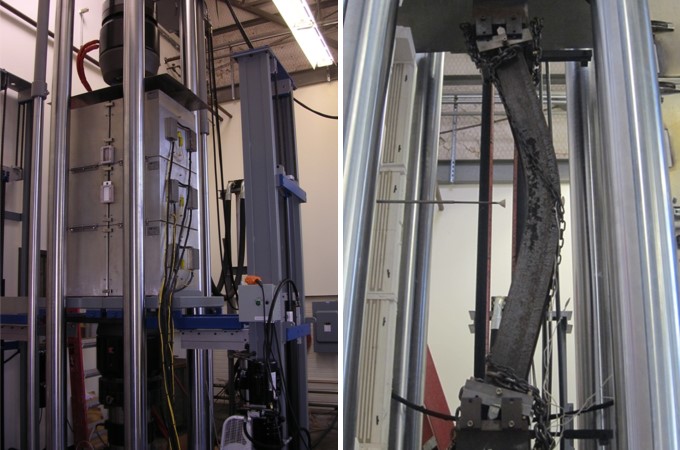
About This Project
The Euler's Column Buckling Calculator provides comprehensive structural analysis for determining the critical buckling load and stress of long columns under axial compression. Using Euler's classical buckling theory, the calculator computes both the slenderness ratio and critical loads considering multiple end conditions and bracing configurations.
The calculator supports two analysis methods: SOLVE mode calculates the ratio of gyration from moment of inertia values (Ix, Iy), while GIVEN mode accepts pre-calculated R values. It evaluates slenderness ratios for both X and Y axes with separate bracing considerations (top and bottom segments), automatically identifying the controlling axis for design.
Key Calculator Features
- Multiple end condition support (K = 0.5, 0.7, 1.0, 2.0)
- Dual-axis buckling analysis (X-axis and Y-axis with bracing)
- Flexible R calculation: SOLVE from I values or use GIVEN R values
- Four Pcr calculation cases plus custom Fcr input option
- Real-time live calculations with automatic updates
- Results rounded to 3 decimal places for precision
Academic Project
Developed by
Renato Frecia IV
Bicol University
College of Engineering
Class of 2025
Built With
Professional Column Buckling Analysis
Calculate critical buckling loads and stresses for columns using Euler's elastic buckling theory
Step-by-Step Analysis
Five comprehensive steps guide you through the calculation: given values, K factors & R calculation, slenderness ratios, critical stress (Fcr), and critical load (Pcr) with live updates.
Flexible Input Methods
Choose SOLVE mode to calculate R from moment of inertia values (Ix, Iy) or GIVEN mode to input pre-calculated Rx and Ry values directly for maximum flexibility.
Dual-Axis Analysis
Evaluates buckling for both X-axis and Y-axis with separate top and bottom segment bracing, automatically identifying the controlling axis with maximum slenderness ratio.